
Anthropic Launches Claude Sonnet 5.5: Same Price, but Faster and Uses Fewer Tokens
Claude Sonnet 5.5 is the second model in the Claude 5.5 family. It costs exactly the same per token as Sonnet 5. What changed is that it generates output over 30% faster and uses fewer tokens for the same work, alongside a big jump in benchmark scores.
By Nattapon YongpaiboonCo-founder, Claude Thailand Community
Anthropic has launched Claude Sonnet 5.5, the second model in the Claude 5.5 family after Opus 5.5.
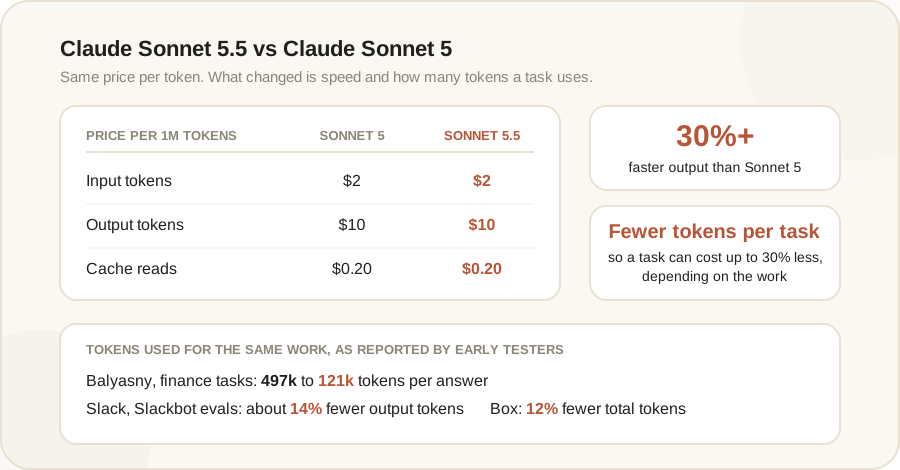
The first thing to know is that the price hasn’t dropped. Sonnet 5.5 costs exactly the same as Sonnet 5: $2 per million input tokens, $10 per million output tokens, and $0.20 per million tokens for cache reads. Two things genuinely improved: it generates output more than 30% faster, and it finishes the same work using fewer tokens.
Sonnet 5.5 is positioned as the faster, more economical complement to Opus 5.5. Opus 5.5 remains the choice for complex work requiring careful judgment, while Sonnet 5.5 is strongest at well-scoped everyday tasks, fixing bugs, and creating polished documents, slides, and spreadsheets. Anthropic adds that it also has a sharp eye for design.
The price didn’t drop, so will your bill?
What you pay for AI is the price per token multiplied by the number of tokens used. This time the first number stays the same, but the second goes down, because Sonnet 5.5 finishes the same work with fewer tokens than Sonnet 5. So your total bill can fall even though the price hasn’t changed.
Anthropic says that in its own testing, cost per task fell by up to 30%. The words “up to” matter: that figure is the best case, not a discount you get every time. How much you actually save depends on the kind of work, as the widely varying numbers from early testers show:
- Balyasny Asset Management ran 2,441 finance tasks, where Sonnet 5.5 used about 121k tokens per answer against 497k for Sonnet 5.
- Slack tested it on Slackbot without changing any prompts and saw about 14% fewer output tokens, with better results on almost all its evals.
- Box saw 12% fewer total tokens, along with higher accuracy and 2.4x the speed.
- Base44 ran 118 real app builds, where Sonnet 5.5 averaged 3.6 iterations per build against 7.7 for Opus 5.
This is different from Opus 5.5, which genuinely cut its per-token price by 20% on top of using fewer tokens. Sonnet 5.5 keeps its price, so any saving comes only from token efficiency.
Benchmark scores
- Terminal-Bench 4.0 (agentic coding): 70.6%, against Sonnet 5’s 10.3%, and above Opus 5.5’s 66.4%.
- GDPval-AA v2.1 (real work across 44 occupations): 1844, just two points behind Opus 5.5 at 1846, and around 400 points above Sonnet 5 at 1449.
- CursorBench 4.0: 55.5%, against Sonnet 5’s 34.1% and Opus 5.5’s 57.8%.
- OSWorld 2.1 (computer use): 80.1%, against Sonnet 5’s 57.0%.
- It is the first Sonnet model to beat Pokémon Red working only from screenshots.
Anthropic states plainly that benchmark scores capture only one facet of a model’s capabilities, and that in both its own testing and external testing, Opus 5.5 remains clearly stronger at complex, open-ended work requiring sustained judgment.
Documents and design work
Early testers highlighted improvements that are harder to measure: a more natural conversational partner, and a knack for design that adds polish to user interfaces and follows slide templates closely enough that decks need minimal editing.
Anthropic describes an internal test where it supplied a public company’s quarterly earnings materials and call transcripts along with a slide template, then asked for a 10-slide operating review. Two experts judged the first draft ready to send as is.
Safety
On the automated behavioral audit covering roughly 1,850 scenarios, Sonnet 5.5 improves on or matches Sonnet 5 on most measures of alignment, resistance to misuse, and honesty. On newer containment evaluations it comes close to Opus 5.5, the best model Anthropic has tested.
Because its cybersecurity capabilities are now comparable to Opus 5’s, it is the first Sonnet model to launch with cyber safeguards. Higher-risk cybersecurity tasks visibly fall back to Sonnet 5, while routine software development is unaffected. Its biology safeguards are the same as Sonnet 5’s.
Where you can use it
Sonnet 5.5 is available on all platforms, including Amazon Web Services, Google Cloud, and Microsoft Azure. Developers can get started on the Claude Platform with claude-sonnet-5-5. The default effort level is Medium in Claude Code and the Claude apps, and High on the Claude Platform.
If you run Sonnet with thinking off, you need to switch to the new between_tools setting before moving to Sonnet 5.5, as described in Anthropic’s migration guide.
Claude Haiku 5.5, built for high-volume and cost-sensitive applications, will join the family in the coming weeks.
Editor’s take
Going by the price tag alone, Sonnet 5.5 isn’t any cheaper. What I find interesting is that it finishes the same work with fewer tokens, like Balyasny’s drop from 497k to 121k tokens per answer. How much you’ll actually save is something to test on your own work, because testers’ results vary widely, from around 12% fewer tokens to roughly three quarters fewer. For everyday work like fixing bugs, building slides, or summarizing documents, the 30%+ speed gain is probably what you’ll notice most. For long, complex reasoning, Anthropic itself still points you to Opus 5.5.
Have you tried Sonnet 5.5 yet? Does it feel faster, or has your bill actually gone down?
The information in this article is based on Anthropic’s official announcement at anthropic.com. Read the original source in the link below.
Get it by email
New articles, Claude updates and community event announcements. Sent occasionally, never often enough to annoy you.
The newsletter is written in Thai