
Anthropic Launches Claude Haiku 5.5: About 75% Cheaper, Its Fastest Model, and the First Haiku With Adjustable Effort
Claude Haiku 5.5 is the cheapest, fastest, and most capable small model Anthropic has released. It costs about 75% less to run than Haiku 4.5 on average. Alongside it, Anthropic is halving Sonnet 5.5 cache read prices and adding a monthly API credit for Max and Team subscribers.
By Nattapon YongpaiboonCo-founder, Claude Thailand Community
Anthropic has launched Claude Haiku 5.5, the third model in the Claude 5.5 family after Opus 5.5 and Sonnet 5.5. Anthropic calls it the cheapest, fastest, and most capable small model it has ever released.
This time the price really does drop. On average, Haiku 5.5 costs about 75% less to run than Haiku 4.5, and it is the first Haiku with an adjustable effort setting.
The same announcement carries two more pieces of good news:
- Sonnet 5.5 cache reads are now half price, which makes most agentic work about 20% cheaper
- A monthly API credit for Max and Team subscribers, for building apps and agents on the Claude Platform
What Haiku 5.5 is for
Haiku 5.5 is designed for high-volume, cost-sensitive tasks. Anthropic gives three groups of examples:
- Quick and repetitive workloads such as summaries, compactions, database queries, and classification requests
- Subagent work on coding tasks, paired with Opus 5.5 and Sonnet 5.5 as the lead
- Speed-sensitive tasks such as live customer support and browser use, because it is Anthropic’s fastest model at standard speed (it still runs less quickly than Opus models in Fast Mode)
New pricing, split by prompt size
Haiku 5.5 has two price tiers, split at prompts of 100,000 tokens. Anthropic says around 90% of requests to its previous Haiku model fell in the tier up to 100,000 tokens.
Price per 1 million tokens (USD)
| Item | Haiku 5.5 up to 100k | Haiku 5.5 over 100k | Haiku 4.5 | Sonnet 5.5 |
|---|---|---|---|---|
| Input | $0.10 | $0.50 | $1.00 | $2.00 |
| Output | $0.50 | $2.50 | $5.00 | $10.00 |
| Cache reads | $0.01 | $0.05 | $0.10 | $0.10 |
| Cache writes | $0.125 | $0.625 | $1.25 | $2.50 |
- For prompts up to 100,000 tokens, the price is 90% lower than Haiku 4.5
- For prompts over 100,000 tokens, it is 50% lower
The “about 75%” figure is an average Anthropic calculated from the real mix of requests, after accounting for the new tokenizer. Haiku 5.5 uses the same kind of tokenizer as Sonnet 5.5 and Opus 5.5, so it uses slightly more tokens per task. Allow for that if you are working out your own budget.
Benchmarks
The table from Anthropic’s announcement compares Haiku 5.5 with Haiku 4.5, GPT-6 Luna, and Sonnet 5.5 (included for reference).
| Evaluation | Haiku 5.5 | Haiku 4.5 | GPT-6 Luna | Sonnet 5.5 |
|---|---|---|---|---|
| GDPval-AA v2.1 (knowledge work) | 1620 | 735 | 1437 | 1840 |
| AA-Briefcase v1.1 (knowledge work) | 1578 | 614 | 1336 | 1824 |
| OSWorld 2.1 offline subset (computer use) | 72.4% | 15.7% | 48.9% | 83.9% |
| Humanity’s Last Exam, no tools | 45.9% | 10.2% | not reported | 56.9% |
| Humanity’s Last Exam, with tools | 57.4% | 18.7% | not reported | 64.5% |
| Terminal-Bench 4.0 (agentic coding) | 39.2% | 0.0% | 16.4% | 70.6% |
| FrontierCode 1.1 Main (agentic coding) | 46.4% | not reported | 42.4% | 52.1% |
| Chartography, no tools (visual reasoning) | 46.4% | 6.4% | 29.1% | 61.6% |
Haiku 5.5 is far ahead of Haiku 4.5 on every row, and behind Sonnet 5.5 on every row too, most clearly on complex coding.
Adjustable effort for the first time
Haiku 5.5 is the first Haiku-class model with an adjustable effort setting. There are five levels: Low, Med, High, Xhigh, and Max. As with Anthropic’s other models, you choose whether to optimize for cost or intelligence.
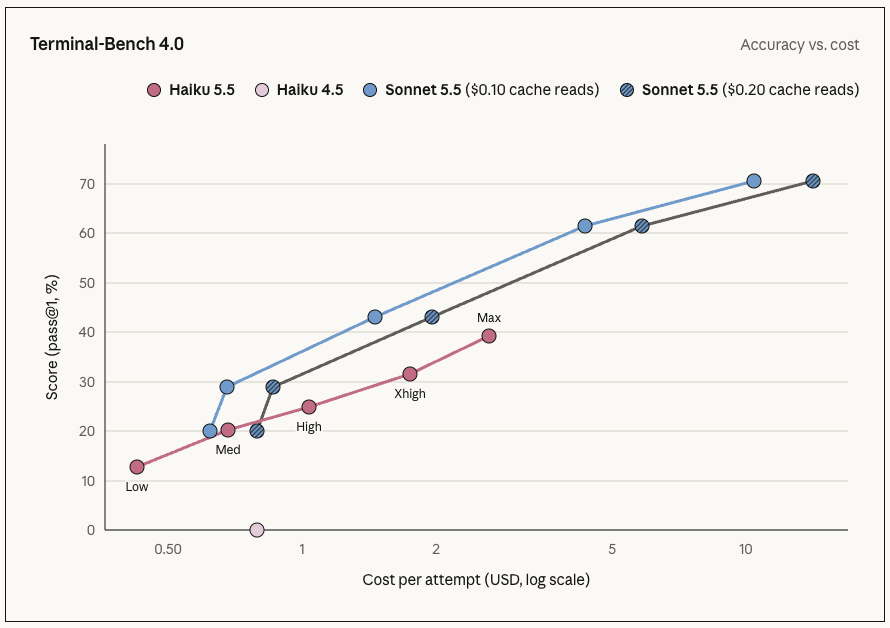
The chart shows two things:
- Pink line (Haiku 5.5): more effort means a higher score, up to 39.2% at Max. Haiku 4.5 scored 0%
- Blue and gray lines (Sonnet 5.5): the same scores, but the blue line with the new cache read price sits to the left. You pay less for the same result
Anthropic uses this chart to make a point: Sonnet 5.5 and Opus 5.5 remain better choices for complex agentic coding. Haiku 5.5 is best suited to more narrowly scoped tasks, such as compaction, summarization, or subagent work, that might previously have been cost-prohibitive with Claude.
What early testers said
- Asana tested it with AI Teammates and saw over a 30% reduction in latency for task completions and up to 2.5x faster inference per agent turn, compared with the model it uses today
- HubSpot got 92.8% averaged over three runs on its CRM task suite, the best score it has seen on that suite
- AlphaSense ran 400 queries on a document Q&A feature that handles about 8 million calls a week, scoring 0.84 against 0.76 for Haiku 4.5
- Box saw a score 11 points higher than Haiku 4.5 at about half the latency
- Rogo uses it as a subagent to pull figures from a 10-K while a bigger model builds the deck
- Cognition uses it as the sidekick in Devin Fusion with Opus 5.5 as the lead, holding a FrontierCode score of 66.2 while cutting cost and latency
Sonnet 5.5 cache reads cut in half
Starting today, cache reads on Sonnet 5.5 drop from $0.20 to $0.10 per million tokens. Other prices stay the same.
Because cache reads make up a large share of the tokens a model consumes in agentic work, Anthropic says this reduces the cost of Sonnet 5.5 on most agentic tasks by around 20%.
A monthly API credit for Max and Team
This week Anthropic will roll out a new monthly API credit to Max and Team subscribers for use on the Claude Platform.
| Plan | Credit per month |
|---|---|
| Max 5x | $100 |
| Max 20x | $200 |
| Team | Up to $500, pooled across the team |
The credits are meant for experimenting with tools, apps, and agents that call the API, and they can be used on any model.
For developers, the Claude Python and TypeScript SDKs now add support for computer use and browser use in beta. Anthropic says Haiku 5.5 is especially well suited to those tasks.
Safety
- Alignment: major improvements over Haiku 4.5 across almost all evaluations, with far fewer instances of misaligned behavior and a lower willingness to cooperate with misuse
- Cybersecurity: safeguards are more restrictive than Haiku 4.5’s but somewhat less restrictive than those on other recent models. They permit a wider range of defensive tasks than Sonnet 5.5’s safeguards, but still block penetration testing and techniques more likely to be used by attackers
- Biology: the same safeguards as Sonnet 5, Sonnet 5.5, and Opus 5
Availability
Haiku 5.5 is available now on all platforms, including Amazon Web Services, Google Cloud, and Microsoft Azure. On the Claude Platform, developers can use claude-haiku-5-5, and there is a migration guide.
The author’s take
The number to remember from this announcement is the 100,000-token line, because the two tiers differ by a factor of five. If you design a system around Haiku 5.5 and can keep prompts under that line, the cost is very low. Ten cents per million input tokens turns jobs like classifying messages, summarizing documents in bulk, or sending a subagent off to look something up into work you can run at a volume that was not worth it before.
This should not be read as Haiku 5.5 replacing Sonnet. A Terminal-Bench score of 39.2% against 70.6% makes it clear that complex coding still belongs to Sonnet 5.5 and Opus 5.5. The pattern Anthropic itself recommends is to let the bigger model think and have Haiku do the subtasks.
For members of our group on Max, an API credit of $100 to $200 a month is a good chance to try building your own app or agent without a separate top-up. If you try Haiku 5.5, tell the group how it went.
The information in this article is based on Anthropic’s official announcement at anthropic.com. All benchmark figures are as reported by Anthropic. Read the original source in the link below.
Get it by email
New articles, Claude updates and community event announcements. Sent occasionally, never often enough to annoy you.
The newsletter is written in Thai