
Announcement: Claude Singapore Community opens exam access for Claude Certified Architect - Foundations
If you have wanted to sit Anthropic Claude Certified Architect - Foundations exam but could not register without a partner-domain email, Claude Singapore Community is now opening access to applicants.
By Nattapon YongpaiboonCo-founder, Claude Thailand Community
If you’ve wanted to sit Anthropic’s Claude Certified Architect - Foundations (CCA-F) exam but couldn’t register because the system doesn’t accept personal email addresses, there’s now a route.
Claude Singapore Community, the Claude user community in Singapore, asked us to share this with our members: they’re opening applications for partner-domain email access so you can register for the exam. Claude Labs is a member of Anthropic’s Claude Partner Network (Services Track).
This round is capped at 100 people, and applications close on 1 October 2026. If you’re interested, apply soon.
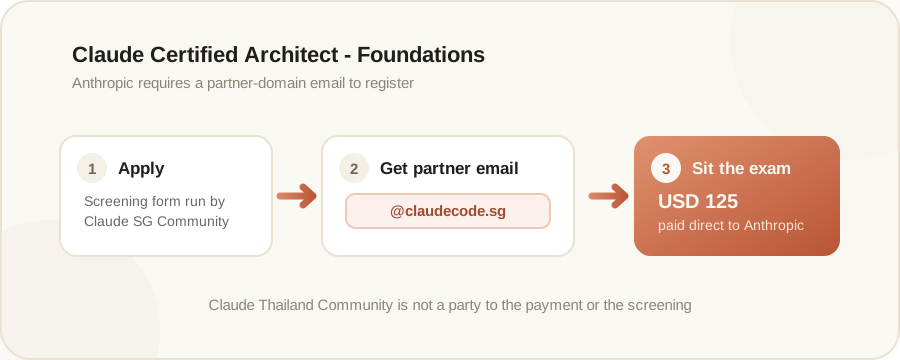
Why this step is needed
Anthropic makes its certification exams available to people whose organisation is in the Claude Partner Network. The registration system doesn’t accept personal addresses like Gmail or Outlook. What this programme provides is access to a @claudecode.sg address so you can clear that requirement.
What you get is email access, not the exam itself and not a discount. You still pay the full fee, and you still sit the exam yourself.
What the exam covers
Per Anthropic, CCA-F tests foundational knowledge across Claude Code, the Claude Agent SDK, the Claude API, and Model Context Protocol (MCP), the core technologies used to build production-grade applications with Claude.
- USD 125, paid directly to Anthropic by credit card.
- Retakes require waiting periods of 14 / 30 / 90 days depending on the attempt, capped at 4 attempts per rolling 12 months.
- During the exam: no AI tools, no notes, no extra devices. Misconduct may result in disqualification.
Best suited to people already building with Claude Code, the Agent SDK, the API, or MCP.
How to apply
Fill in the screening form at ccaf-onboarding.claudecode.sg/screening.html
The form asks for your full name, personal email, LinkedIn URL, Telegram handle, company, role, and a description of the work you do (between 250 and 3,000 characters).
Once screened and registered, you must send proof of your exam registration to the organisers on Telegram within 48 hours.
Things to know before applying
- Claude Thailand Community is not a party to the payment or the screening. We’re sharing this announcement only. The exam fee goes directly to Anthropic, and screening plus email issuance is handled by Claude Singapore Community.
- The form asks for a fair amount of personal information, including your Telegram handle and work history. Read it and decide for yourself before filling it in.
- The form is built primarily for applicants in Singapore. The name field asks for your name as per NRIC, which is a Singaporean identity document. Applicants from Thailand should check with the organisers which document to use instead.
- The certification is valid for 12 months.
Details in this article come from the Claude Singapore Community screening page and Anthropic’s official certification page at anthropic-partners.skilljar.com. Terms may change, so check with the source before deciding.
Get it by email
New articles, Claude updates and community event announcements. Sent occasionally, never often enough to annoy you.
The newsletter is written in Thai