
Claude Managed Agents Can Now Run on Your Own Infrastructure, in a Self-Hosted Private Beta
Anthropic has opened a private beta of self-hosted Claude Managed Agents. Organizations can run the agent harness, sandboxes, and session history in their own cloud or on-premises, and choose where requests to Claude are sent. It is aimed at work that needs access to code and internal systems.
By Nattapon YongpaiboonCo-founder, Claude Thailand Community
Anthropic has opened self-hosted Claude Managed Agents as a private beta.
Claude Managed Agents runs Claude as a long-running agent, with Anthropic providing the pieces it needs: the agent harness, sandboxes for running commands, credential handling, and session history. See also connecting Managed Agents to Vercel’s Chat SDK.
With the self-hosted version, organizations run every part of the service in their own cloud or on-premises, and choose where requests to Claude are sent.
What it’s for
It is aimed at agents that run unattended on your code and need access to your internal systems, such as:
- Fixing broken builds
- Testing releases
- Triaging alerts
- Working through bug backlogs
How it fits together
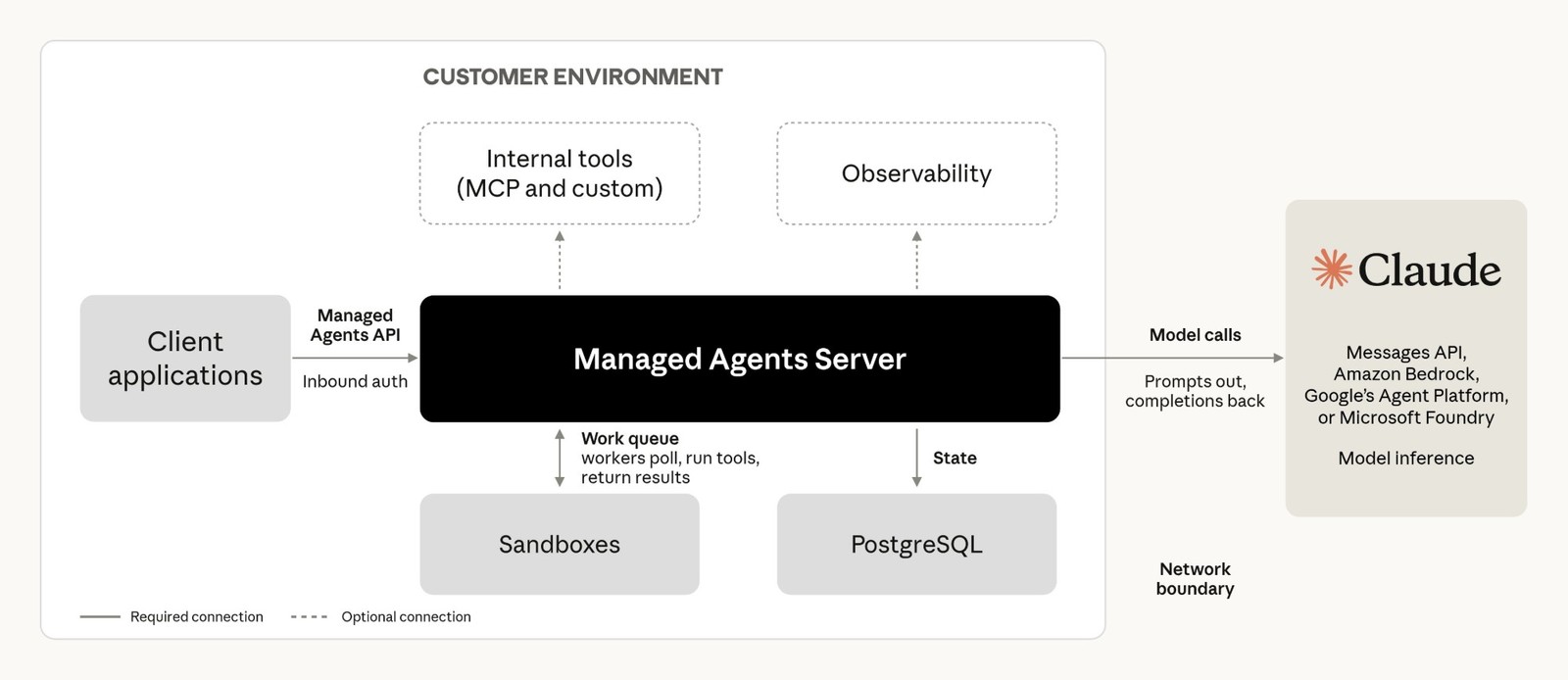
According to the self-hosted Managed Agents documentation, you run:
- The server, which serves the API, runs the agent loop, and stores agents, sessions, and each session’s history. The server never runs shell commands or edits files itself
- A database, PostgreSQL 16 or later
- Workers, which take work from the server and run the agent’s shell and file tools in your sandboxes
- A console on your server, where people sign in through your identity provider to create agents and run sessions
The API matches the Managed Agents service that Anthropic runs, so the SDK and the ant CLI work as before. Some features exist only on the hosted service, so check the list of differences in the documentation before you decide.
Choose where model calls go
The model still runs at Anthropic or at a provider you choose. The server can send requests to:
- The Claude API at Anthropic (the default)
- Amazon Bedrock
- Google Cloud
- Microsoft Foundry
- Your own model gateway
For each model call, the server sends the conversation so far, including tool inputs and results, to the provider you choose. If you have a Zero Data Retention (ZDR) agreement, it applies to these requests as it does to any Messages API call.
Security
- Brain and hands are split. The harness calls Claude, the sandbox runs the agent’s code, and sandboxes start only when a tool needs them
- Credentials stay out of the sandbox. For MCP tools and supported API calls, a proxy outside the sandbox adds the credential to the request, and you can keep credentials in your own secrets manager
- Network access can be limited. Set an allowlist of hosts, such as your git host and package registry, and requests to any other host are blocked
- Every step is recorded. Each step of a session, including tool calls and their results, is recorded and can be exported over OpenTelemetry to the monitoring tools you already use
Keep in mind that running it yourself moves responsibilities from Anthropic to you, including securing the server and installing each release. The documentation warns that the agent’s bash tool is a real shell, and isolation depends on running workers in a separate container or VM.
Who can use it
The private beta is only available to eligible organizations. You can request access through your Anthropic account team. The announcement does not mention pricing.
Get it by email
New articles, Claude updates and community event announcements. Sent occasionally, never often enough to annoy you.
The newsletter is written in Thai