
Anthropic launches the Model Hardware Standard, letting AI agents operate real lab and factory equipment
Anthropic announced the Model Hardware Standard (MHS), a shared specification letting AI agents operate different brands of scientific and manufacturing hardware through one common language. Integration drops from weeks to hours. Research preview open to applying labs and manufacturers first.
By Nattapon YongpaiboonCo-founder, Claude Thailand Community
What’s changing
Anthropic announced on 27 August 2026 the launch of the Model Hardware Standard (MHS), a shared specification for AI agents to safely operate physical devices in scientific labs and manufacturing facilities. It’s currently in its first research preview.
The problem MHS solves
Connecting each piece of hardware to an automation system has traditionally meant writing separate code per brand, since every device has its own interface. Anthropic states this process typically takes weeks, if not months, per setup.
MHS solves this with a shared driver that translates commands into simple primitives like read and write that any device can understand, cutting integration time down to hours or minutes.
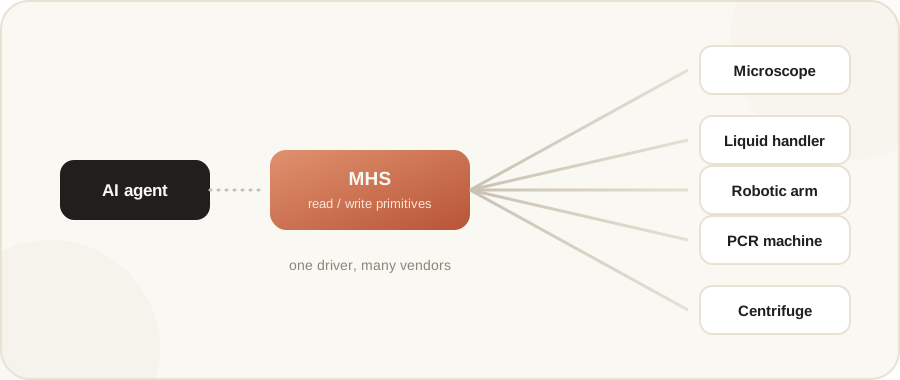
Supported devices cover anything with a programmable interface, including liquid handlers, robotic arms, microscopes, plate readers, PCR machines, centrifuges, cameras, laser systems, and motorized stages.
Who helped build and test it
Anthropic developed MHS primarily with HHMI Janelia Research Campus, alongside several testing partners, each with results confirmed in the announcement.
- Janelia Research Campus unified a microscopy rig that previously needed seven separate vendor programs into one system, cutting hardware integration from multi-day projects down to minutes, and enabling real-time analysis with agentic microscope control. It’s used to image neurons and dendrites deep in the brains of living mice.
- Genentech had Claude coordinate a BCA protein assay across a liquid handler, robotic arm, and plate reader. Claude independently optimized flow rates, around 140 microlitres per second for water and 10 microlitres per second for the more viscous BSA, while demonstrating autonomous error recovery.
- University of Washington (Baker and Pinglay Labs) built a remote monitoring dashboard, ran AI-supervised qPCR that watches amplification curves and stops at the optimal moment, and coordinated collision-free plate handoffs between a robotic arm and liquid handler. Setup took under a week, versus the usual months.
- Carnegie Mellon University ran serial dilution dose-response experiments roughly 3x faster, coordinating four devices across three incompatible computer interfaces. The system independently rejected poor results and reran experiments with adjusted parameters. Integration took 8 hours total, versus the usual several weeks.
- QuEra Computing built a laser frequency recovery controller with a 99.3% success rate, cutting recovery time from 5-10 minutes down to 0.9-14 seconds depending on how severe the disturbance was.
Who can use it now
This round is open only to scientific research labs and advanced manufacturers, not the general public yet. Apply at modelhardwarestandard.com.
Anthropic says MHS will eventually go open source, but for now it wants to work with partners on safety evaluations and best practices before opening it up publicly. Hardware vendors already adding MHS support include Amazon Web Services (via Strands Robots), Automata, Doosan Robotics, Tecan, Universal Robots, and QIAGEN.
The writer’s take
I think this is a genuinely different kind of step compared to most Claude news so far, since it’s the first time Anthropic has built a standard for AI to control physical equipment systematically, not just clicking around a screen the way computer use does. If this project goes well, I’d expect to see its impact spread widely across research and manufacturing over the next few years.
Details in this article come from Anthropic’s official announcement at anthropic.com/news, published 27 August 2026. Read the original post via the source link below.
Get it by email
New articles, Claude updates and community event announcements. Sent occasionally, never often enough to annoy you.
The newsletter is written in Thai